Thursday, November 30, 2023

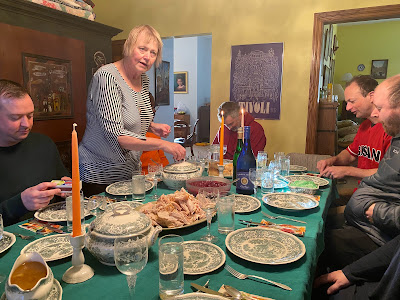
Thanksgiving 2023, visiting my quilts (and my sisters)

My sister's kleiderschrank with quilts piled above.
Some are mine.

A quilt signature quilt of mine from our family gathering in the mid 1990s.
Beth is eating oyster stew, our family's traditional meal after the harvest is complete.
Lynn, Beth, Janna
The Dykstra Sisters, sitting on their parents' davenport.
And remembering what
an excellent jumping on davenport it was.
It belongs to Janna now, who had the pokey broken spring repaired.
orange rind garland making!

Hammers add to the fun

smells and looks good!
A full table, around and atop.

Tuesday, October 03, 2023

bernina x 64, quilt completed


Bernina x 64
about 70 inches square
Top completed 2022
Quilt completed 2023
Quilted by Sue Divarco

I explain the piecing of the quilt at HERE. I was inspired by Warhol's Marilyn x 100 that hangs in the Cleveland Museum of Art.
I used a slightly altered Fat Quarters Shop's Sewcialities block 33 by Lori Holt.
Made with solid fabrics, mainly Kona and Moda. Border is Kona Glacier.
It was a fun block to sew. The 64 was for me being 64 when I pieced it.

A new building has gone up a block to the west and I am having trouble picking the right time/cloud cover for quilt photography. And also trouble finding willing family members for quilt photography. I have quite the backlog of finished quilts to post!

Friday, September 22, 2023

ocean waves, layout options


There are many options in layout, but I played with these two until I committed.

Block pressing would have been different for each layout.
When this block was pieced by hand it was pieced with odd shaped segments.
Which I was not going to do. This left me with these two choices.

A: Traditional with geese half solid half print

Traditional and most frequently seen in vintage quilts
Note all the intersections are similar in shape.
Blocks are set so at every intersection of four blocks there are two triangle effect corners and two rectangle effect corners to make the center on-point square.
With this layout, there is that fun nip out in the center square on point that happens where four blocks come together.
I like those bits "chewed out".
Note the triangles when they meet make geese that are half solid/half print.
However, it just felt more chaotic than I was wanting for one of my multi-fabric, multi-scale, multi-color, and multi-value quilts.


SO, I am going with:

B: Traditional with all solid and all print geese

Also traditional, but not as frequently seen in vintage quilts
Note: intersections are varied, either a plus shape or a square on point shape.
Blocks are set so at every intersection of four blocks there are either four triangle effect corners or four rectangle corners.
I like how the solids stand out a bit more in this setting with this mix of fabrics.
With my multi-everything quilts, I like to keep a bit of structure that isn't always evident. I keep a strong grid. I like and include my "ghost" blocks but keep enough high-contrast blocks that the pattern stands out.
I also keep directional fabrics directional within the block--and these blocks directional in the quilt.
A bit of order keeps these chaotic quilts in check.

Now, on to making about 20 remaining of the needed 120 blocks and get this thing put together! Christmas is my goal.

Saturday, August 26, 2023

ocean waves, block construction

Ocean Waves
Block finishes 8 inches
A block I have long wanted to use.
I have two separate pressing plans, an A block and a B block, which will help with top construction.
(((I have updated this post with my revised pressing plan)))

Both start out similarly

Cutting
Solid: 12 half square triangles cut from 2 1/2 inch strips using EZ angle or Bonnie Hunter's essential triangle tool
Print: 12 half square triangles cut from 2 1/2 inch strips using EZ angle or Bonnie Hunter's essential triangle tool, two 2 1/2 inch squares, one 2 1/2 by 4 1/2 inch rectangle
Make 12 squares using the solid and print triangles, press towards the solid
Lay out pieces and sew into four rows, press as shown.

At this point, make half the blocks with A pressing:


Sew rows together and press all seams toward the row with the rectangle.

And make half the blocks with B pressing:


These blocks will be set into 4-block units of all A or all B, rotating so the rectangles are on the outsides and the center brings together the triangles.

In developing my pressing plan, I found it all nests except for the triangles in the centers of these 4-block units. Careful sewing kept the points meeting fine.

I plan to make 120 blocks, set 10 across and 12 down. So 15 4-block unit A and 15 4-block unit B.
I'll detail the top construction in a post when I get that far!

My directions of a traditional block. Use at your pleasure.

Monday, July 31, 2023

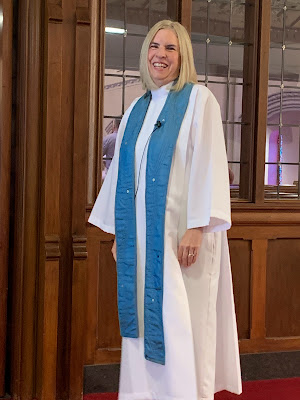
a new liturgical piece--ordinary time stole for a new pastor


I had retired from making liturgical pieces. I find them taxing to make in the over-thinking I do in how they will look from a distance and close up, symbolism, how to personalize them, how to make them meaningful. It takes a lot out of me!

This spring when Rev. Nickerson joined our pastoral staff, the church asked me to make one as a gift from the congregation and, though overwhelmingly busy with work, stepped in as I had some ideas.

Ordinary time is a special time in the liturgical calendar as there is nothing special going on! That appeals to me. How precious ordinary time is.

The color for ordinary time is green. Liz said she favors green on the blue/green side of it and I found a lovely duckegg colored silk from Mood. It is a shot silk. so from different angles it looks dull green to vivid turquoise.  
Because she focuses on family ministry, I liked the idea of duckegg as the children tend to follow her like baby ducks.
I asked for verses/imagery to think of and she mentioned loving verses of eagles on wing and of solid rock foundations.

The piece is quilted with 4 rows of thread making a trinity of channels that look like thermals that eagles glide upon. The lining is a lovely striped linen that reminds me of the limestone wall of St Pauls in the chancel.  

See what I mean that these take a lot out of me? A joy, but, a lot.

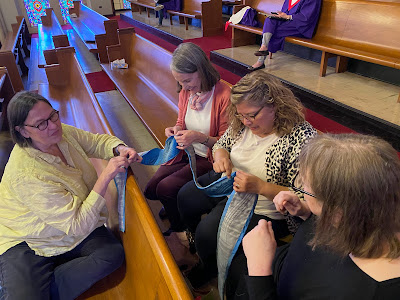
My time was limited to work on this by Installation Sunday, so I put out word to church friends who are good with a needle to meet me in the balcony with their thimbles to help with the handwork of the binding. We sewed through the second hymn of the service to get it finished in time for the installation after the sermon. Sneaked it up the side aisle.


Members of the congregation signed lining at the reception and I like the idea of them embracing with love. I have a few people select tiny buttons and choose where to place them. 
Ordinary objects representing seeds in ordinary time.

Monday, July 17, 2023

Driven Rain: 16-patch chain, top completed, block and top construction tutorial


Driven Rain: a 16-patch chain
Top completed 2023
96 by 80 inches
120 blocks set 10 across and 12 down
Block finishes 8 inches
Piece count: 1920 total: 480 solid, 1440 scrap

I had let a pile of scraps build up, mainly from taking in other people's fabrics. After several sessions cutting them down, my 2 1/2 inch squares darks and brights bins (two) were topped off and that is my trigger to make a plan to use lots of them.

I keep these size bins active:
2 1/2 inch squares, 2 inch squares, 2 1/2 by 1 1/2 inch rectangles, 1 1/2 inch squares
-Lights/neutrals
-Darks/brights
-30's repros
-Solids
I keep the pieces stacked. This helps me look along the edges for colors I am looking for. Also keeps the pieces from getting wrinkled. Each bin is a quilt ready to happen.

This time I went with a chain of squares in the midst of the darks/brights. I again chose Kona Ice Frappe (SKU# K001-1173). It stands out well in the chaos..

Bins before this quilt

Bins after this quilt!

16-patches are my go-to for both efficiency and creativity. I love this block.

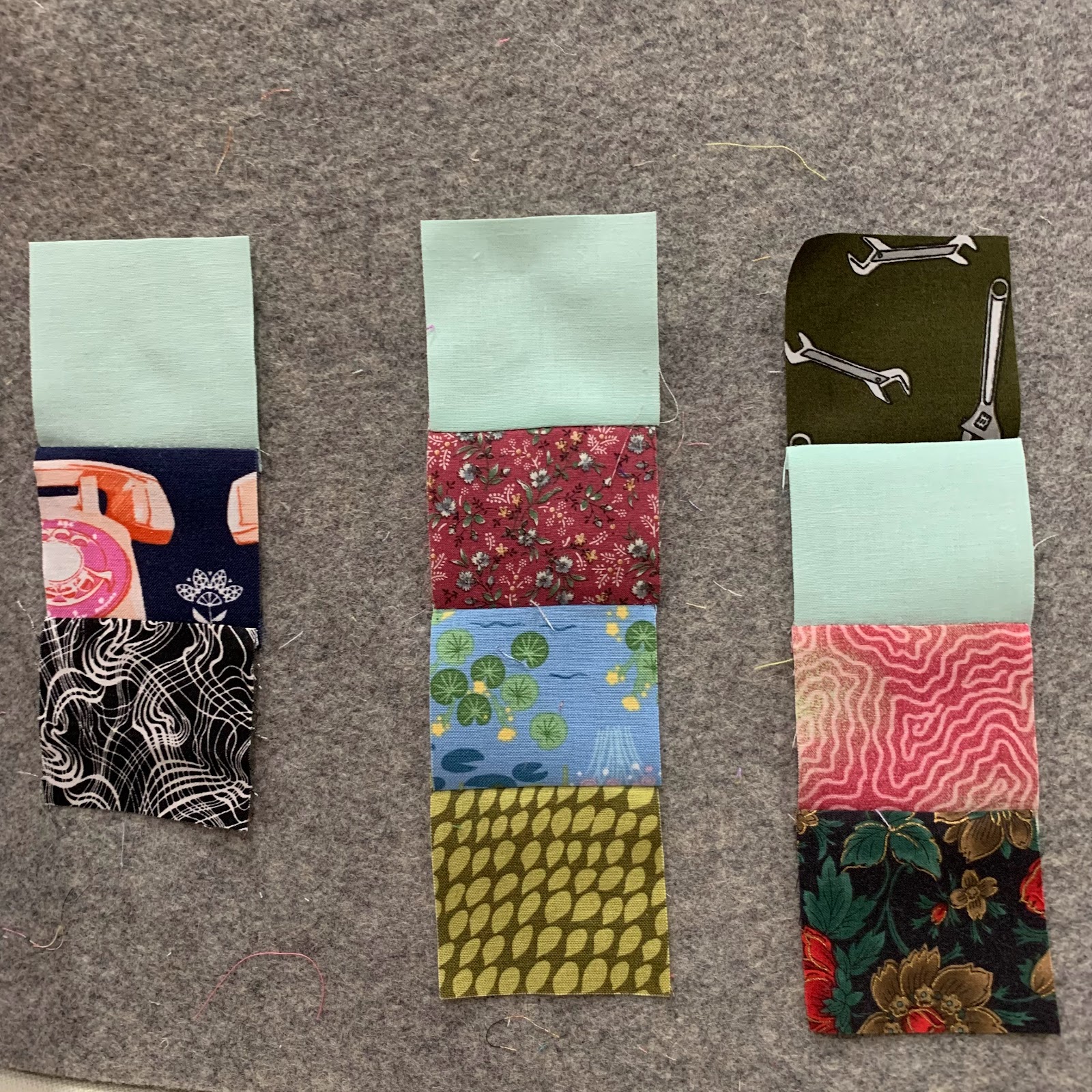
For each block make 4 pairs of scraps and add a solid
Then add a scrap to the bottom of two and to the top of two
Make units then half blocks, pressing units as indicated 
do not press the half blocks
Make blocks by rotate one half block.
Press blocks to one side
Take two blocks, rotate bottom one and sew into pairs
Sew pairs of blocks into fours
Press joining seams in one direction and rotate right one to make into units of 8 blocks
Make 15 units of 8 blocks and lay out into three rows of 5 units
Quilt is 10 blocks across, 12 blocks down, 120 total blocks.
My design--use at your pleasure.
Backing is by Miriam Bos for Dear Stella

Saturday, July 01, 2023

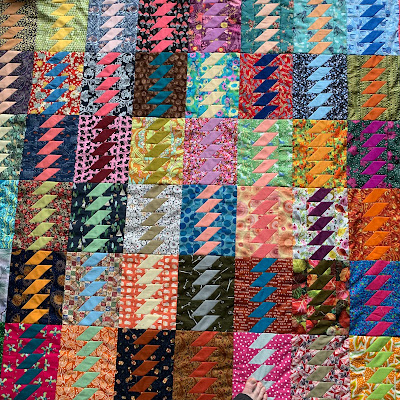
burdock, top completed

Burdock
90 by 80 inches
90 blocks set 9 down and 10 across
Block finishes 8 by 10 inches

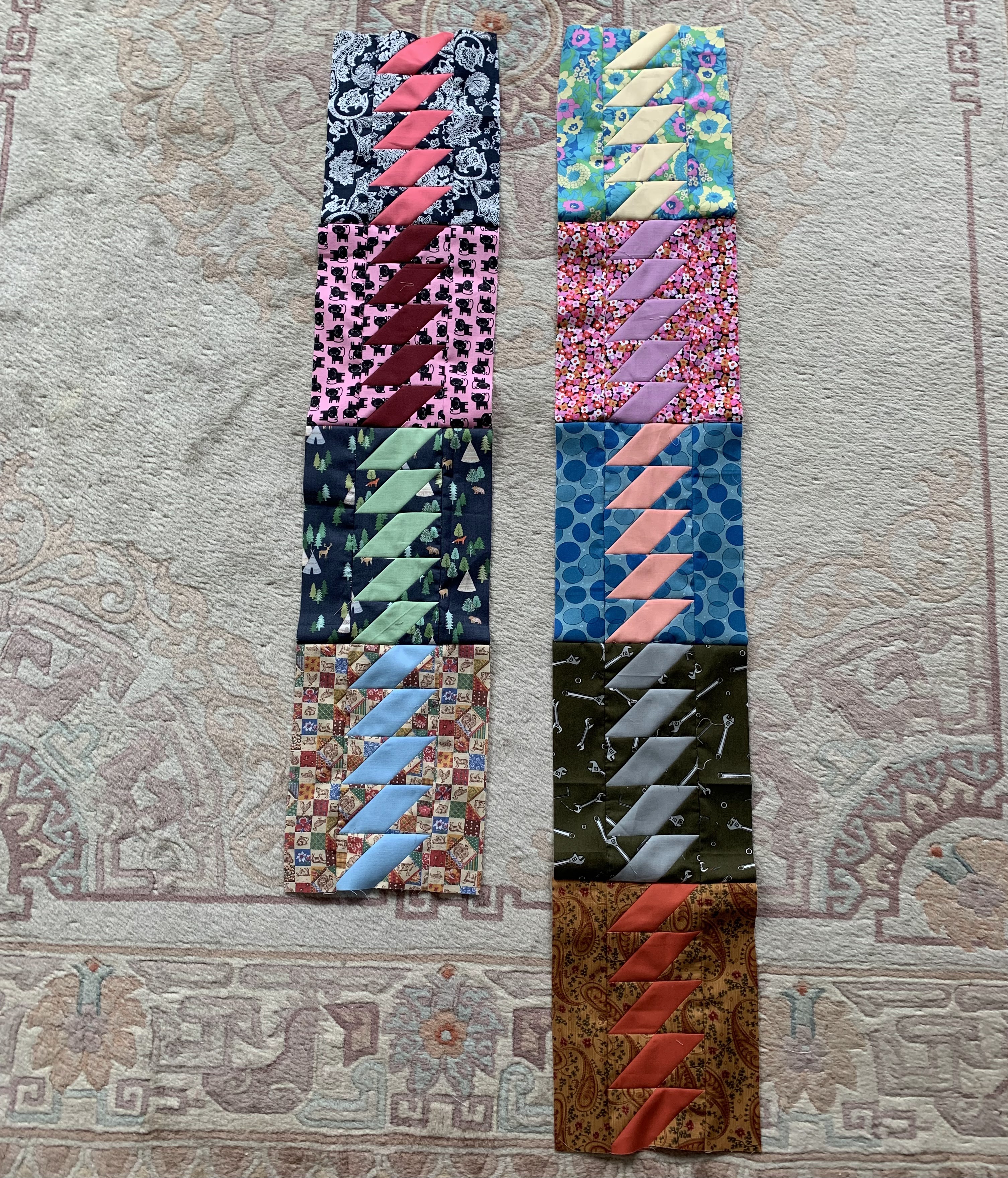
My block piecing directions are here.
*NOTE, I kept all blocks oriented with the burs section pressed south throughout my layout.
This is not required, but helps it all lay flatter.

Assembly 
Set aside 10 blocks.

Remaining 80 blocks
Press half with to the burs, half to the sides.
*Note, the pressed in blocks do not like to be pressed in. I do this mainly to nest, and allow the centers of the blocks to twist back to their prefered status. Twisted sisters seams I call them!
Pair and piece vertically into twos then four vertical block units. alternating the pressings so they are pressed in then out.
Set aside 10 of the units.

Take ten 4-block units and pair into five 8-block units, pressing the left one up and the right one down, and sew. Lay out these 5 units for the top portion of the quilt.

Take remaining 10 units and the 10 set aside blocks. Press those single blocks towards the burs and sew one onto the bottom of each unit.

There are now ten 5-block units
Pair these to make five 10-block units, again pressing the left of the pair up and the right one down.
Lay these five 10-block units out to be the bottom portion of the quilt.
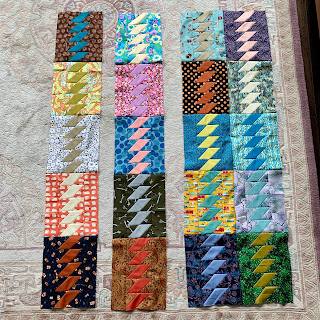
Sew the units into rows, press top row to the right and bottom row to the left and sew the two rows together.
Everything will nest.

My design, use at your pleasure.
Backing by Miriam Bos for Dear Stella