
Thursday, November 22, 2012
more of mom's scraps


Tuesday, November 20, 2012
grandmother's choice--flag, schoolhouse, corn and beans, northwind
I see there are several others of you out there substituting blocks for those where Barbara Brackman uses sadistically odd measures.
I made my own schoolhouse block, and, in honor of our corn harvest and preparing for a soybean crop, chose a Corn and Beans variation. With the Ken Burns' Dust Bowl series on tv this week, I chose a Northwind block. Mom pointed out to us several places along the fencerows of the farm where the dust that built up in the mid 1930s remains and where volunteer trees grew to now large ones. She said at times the dust was red from land in Kansas and Oklahoma, so unlike the black dirt of Iowa.

Here is my mother as a schoolgirl in pigtails, about 1940.

I made my own schoolhouse block, and, in honor of our corn harvest and preparing for a soybean crop, chose a Corn and Beans variation. With the Ken Burns' Dust Bowl series on tv this week, I chose a Northwind block. Mom pointed out to us several places along the fencerows of the farm where the dust that built up in the mid 1930s remains and where volunteer trees grew to now large ones. She said at times the dust was red from land in Kansas and Oklahoma, so unlike the black dirt of Iowa.


Her memories of the Dust Bowl years:
I remember Papa talking about the government ordering all those cattle and hogs to be killed. It seemed such a waste to do that while many people were going hungry. Some of the dust that came to Iowa was the red dust from Kansas and Oklahoma. The Milwaukee railroad went through our land, after the dust storms there were big banks of dirt and dust, just like snow banks. Those banks are still there the little saplings we saw in the thirties and forties are large trees now. There were a lot of prairie flowers along the tracks too.
It was dry and dusty here too, but not as bad as in Oklahoma. Later the grasshoppers came and ate the grain. I think it was in the thirties that they started planting all those big windbreaks in South Dakota to prevent erosion. Hubert Humphrey was a big advocate of that and it did help. Now in the last twenty or thirty years a lot of those windbreaks were destroyed. We saw that in Alaska too, some of the windbreaks were not taken care of and just gone wild.
In North Dakota where they first started mining coal, they did not clean up the area after they removed the coal and that land is full of hills with trees and bushes. But now when the mine is finished, they level the land and plant crops on it. We belonged to the Lyon County REC and our electricity came from those coal mine areas in North Dakota. Dad and I took a couple of bus trips to that area several years ago. It reminded me of the polders in Holland.
‘The Farmers’ Holiday Association’, it was a movement in 1932 – 1934 that got kind of rough in the LeMars and Sioux City area. They even put a noose around a judge’s neck, he was ordering foreclosures on a lot of farmers. I remember hearing about dumping the milk. The Depression was a difficult time. Some people got very desperate. A lot of anxiety in those days. We were poor, and so was everyone else. We felt sorry for the city people. The farmers had cattle, hogs, and chickens to butcher, we canned the meat, because we did not have electricity and freezers. We also had big gardens so we canned a lot of vegetables and applesauce. I remember Mama used a kerosene stove in the summer time to do her canning, cooking and baking. The big stove that used cobs and wood would make the house too hot in the summer.
Saturday, November 17, 2012
making a tree--with apologies to Joyce Kilmer

I used a Timeless Treasures red--this was on the label:
Timeless Treasures 239930 Tonga red B9390
Here is the thing with red--always buy a fabulous red. And lots of it. I bought the bolt. (14.7 yards)
I used about 7 different green batiks. In the quilt I put one lighter green in a different place on the left side of every tree.
(I use the EZ angle in cutting my triangles and will put those measures in parenthesis.)

3 triangles cut from two 6 7/8 squares, cut once diagonally--one left over (cut from 6 1/2 inch strip) I see that two triangles didn't make the picture. They will show up later.
24 triangles cut from twelve 2 7/8 inch squares, cut once diagonally (cut from 2 1/2 inch strips)
3 squares cut 2 1/2 inches
2 rectangles cut 4 1/2 inches by 6 1/2 inches
Tree:
30 triangles cut from fifteen 2 7/8 inch squares, cut once diagonally (cut from 2 1/2 inch strips)
4 squares cut 2 1/2 inches
1 triangle cut from one 6 7/8 squares, cut once diagonally--one left over (cut from 6 1/2 inch strip)
One 4 1/2 inch square
Piece 24 squares with the smaller triangles
Piece one square with the large tree and one of the large background triangles
Use the small tree squares to make sew-and-flip triangles on the 4 1/2 inch sides of the two background rectangles.


I used this block for a pillow to be presented to the Schuenemann family. I added 2 1/2 inch strips on each side before quilting, trimming it all to about 20 inches after quilting then making a lap-back pillow.
Here it is on our new white sofa--are we crazy soon-to-be empty nesters or what?


Sunday, November 04, 2012
morgenrot (red sky at morning) 2012

St Pauls is having a Shuenemann festival this month and asked me to make a quilt to help raise funds for a plaque honoring the family and the ship on the 100th anniversary of the loss. The plaque will be placed on the Clark Street bridge.
Quilt is about 82" by 82". Block is 16 inches finished.
Quilted by Suzette Fisher.
It was a joy to make.
I'll post soon with block instructions.
Sunday, October 28, 2012
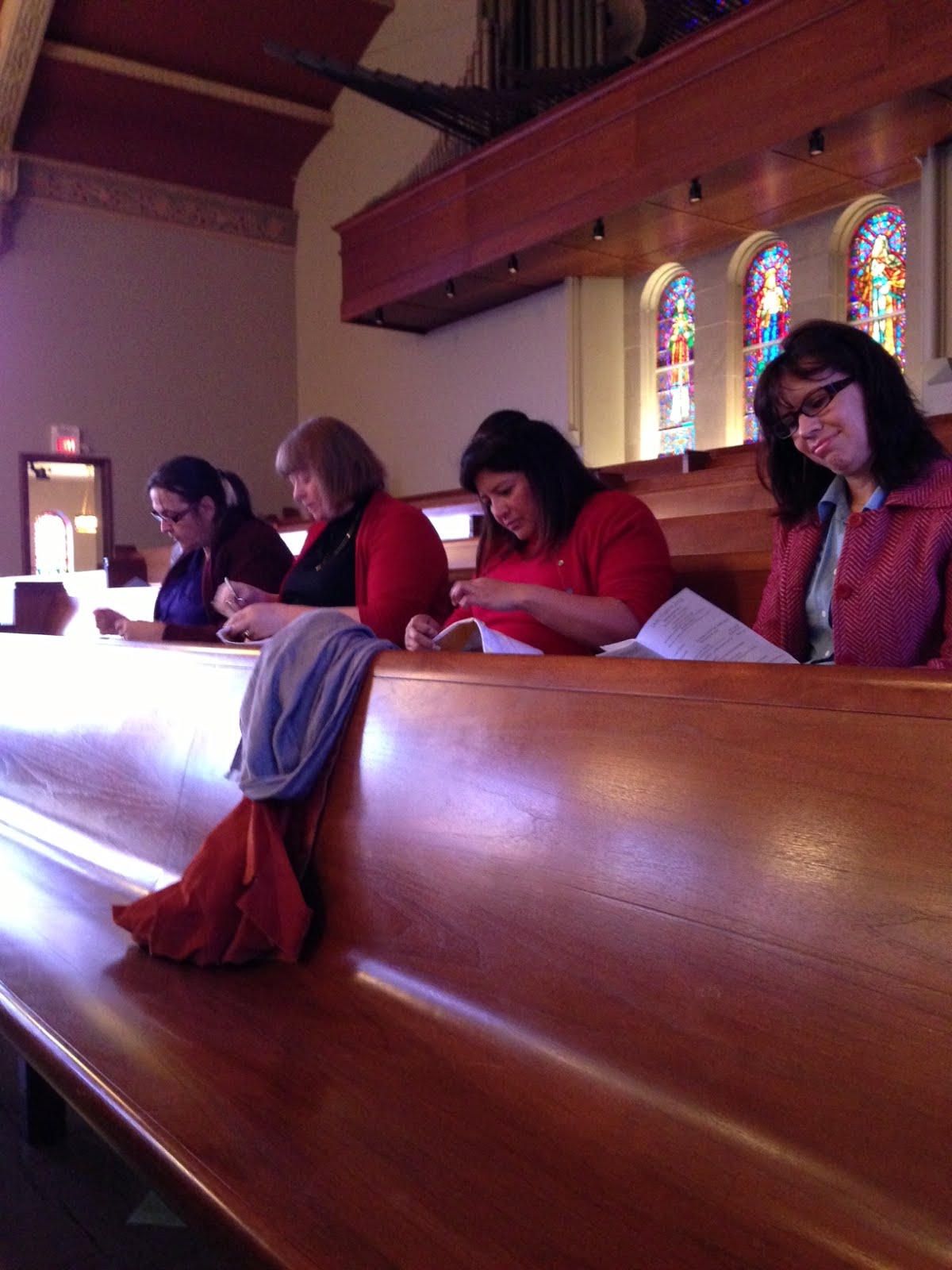
sewing in church

I've been working a lot lately and did not budget enough time to finish it.
I got the machine work completed at about midnight and put out the call to several friends to sit with me in the balcony and work on the binding during this morning's service.
We sewed through the hymns.
We sewed through the sermon.
We sewed through the offertory.
(We put our needles down during the prayers.)
We sewed through the postlude and well after the service.
Finished it 28 minutes before the installation service.
Thank you to Bobbi, Nancy, and Jennifer for keeping me calm and getting it done!

Monday, October 15, 2012
pink spools

Sunday, October 14, 2012
grandmother's choice--Alice's flag, Aunt Eliza's star, New Jersey


Born in New York City. She gave me Italian cooking lessons by mail when Andy and I were newlyweds.
Friday, October 12, 2012
tip # 24 threading the binding


Monday, October 08, 2012
hanging chads

Made from deconstructed shirt parts.
My blocks finish 4 inches square.
Darks, two 2 1/2 inch squares and two 1 1/2 by 2 1/2 inch rectangles.
Lights, two 1 1/2 inch by 2 1/2 inch rectangles. Named for the effect of the notorious ballots.


Saturday, October 06, 2012
mood! swatch!!

I was in New York last week and made a stop at Mood.
It was fun to see the shopping haunts of Project Runway, and of course, the dog Swatch.

I already used bits of them in these spool blocks.
Make it work!

Friday, October 05, 2012
tip #23 speed pressing

I press patches one over the other,
I off set each patch by about 1/2 inches so the seams don't pile up.
Place patch and open with left hand, press with iron in right hand.
Pick up next patch, place about 1/2 inch to left, and press.
Over, and over, and over.
You get a motion and a rhythm going that makes the pressing go very quickly.
Think about what all happens with pressing.
The hot iron relaxes the fibers then dries them under pressure to smooth.
I usually set the seam, pressing the patch as it was sewn. This embeds the sewing thread into the fabric.
But, I find that when I speed or chain press, the warmth of the previous patch relaxes the next patch enough that I can press without setting the seam.
I also do a count as I press to give myself a running total.
In this photograph I was working in sets of 10 for the boatload of half square triangles I needed to make a bunch of trees.


Wednesday, October 03, 2012
tip #22 cutting off dog ears while chain piecing


So instead, I cut the dog ear at the same time I cut the pieces apart, either with a scissors or with a rotary cutter.
One motion to cut apart the chain and cut the dog ear off.
You can not only chain piece, but also chain cut, and chain press! (coming soon, a tip on chain pressing.)
Sunday, September 30, 2012
Dykstra corn, 2012

Sunday, September 23, 2012
some children come to play

Several quilters who have used my tutorials for the children blocks have sent me some of their blocks--THANK YOU!! They are a delight. I love the Olympian Bolt.
Saturday, September 22, 2012
mom's scraps used again in spools

Once again, I am using some of my mother's scraps. Each scrap is a wonderful memory.
Now that I have made many from her scraps, I will work from my own. This is an incentive to keep working on organizing my sewing room.
I am using Kona Cotton Rich Red for my constant.


grandmother's choice--Sunflower

Barbara's block for this week was an intricate sunflower.
I went my own way with a pieced one. Not really happy with the very narrow border I ended up with--may work with it later if it still bothers me.
Third in a series of 49 blocks shared by Barbara Brackman in her block-of-the-week history lesson recalling the fight for women's rights.

Hillegen (Ella), Graada (Carrie), John, Gerrit Jan, Edward
Friday, September 21, 2012
topolobampo


It helps to get a last minute reservation when you sit next to the maitre d' in the church choir.


Saturday, September 15, 2012
grandmothers choice--Union Square

Union Square, third in a series of 49 blocks shared by Barbara Brackman in her block-of-the-week history lesson recalling the fight for women's rights.
http://grandmotherschoice.blogspot.com/

back row: Cornelius, Edward, John, Hillegen (Ella)--my grandmother
front row: Gerrit Jan, Henry, Graada (Carrie Rabbers)
They later moved to Boyden, Iowa where Gerrit Jan was a carpenter.
Subscribe to:
Posts (Atom)
